The Hydraulic Reality of Outdoor Accommodation
If you run a campsite in Europe, you already know the morning rush. At 08:30 on a midsummer Saturday, dozens of guests take showers simultaneously, coffee pots are filled across every pitch, and automatic motorhome rinse stations click on. If your water infrastructure relies on a long, linear dead-end line, the pitches situated at the perimeter will experience an unacceptable drop in pressure, or worse, sputtering air pockets.
Treating water supply and wastewater as an integrated loop rather than individual isolated standpipes is the difference between constant plumbing headaches and an effortless operational season. A robust utility layout requires careful subterranean planning, hydraulic loop balancing, backflow protection, and seasonal dewatering valves.
Looped Water Supply Networks vs. Dead-End Spurs
Many older European campsites expanded incrementally over decades. Whenever a new row of pitches was added, the groundskeeper simply dug a trench and extended a polyethylene pipe from the nearest faucet. While cost-effective in the short term, this approach creates stagnant "dead legs" in low season, which can foster biofilm development and bacterial concerns like Legionella pneumophila.
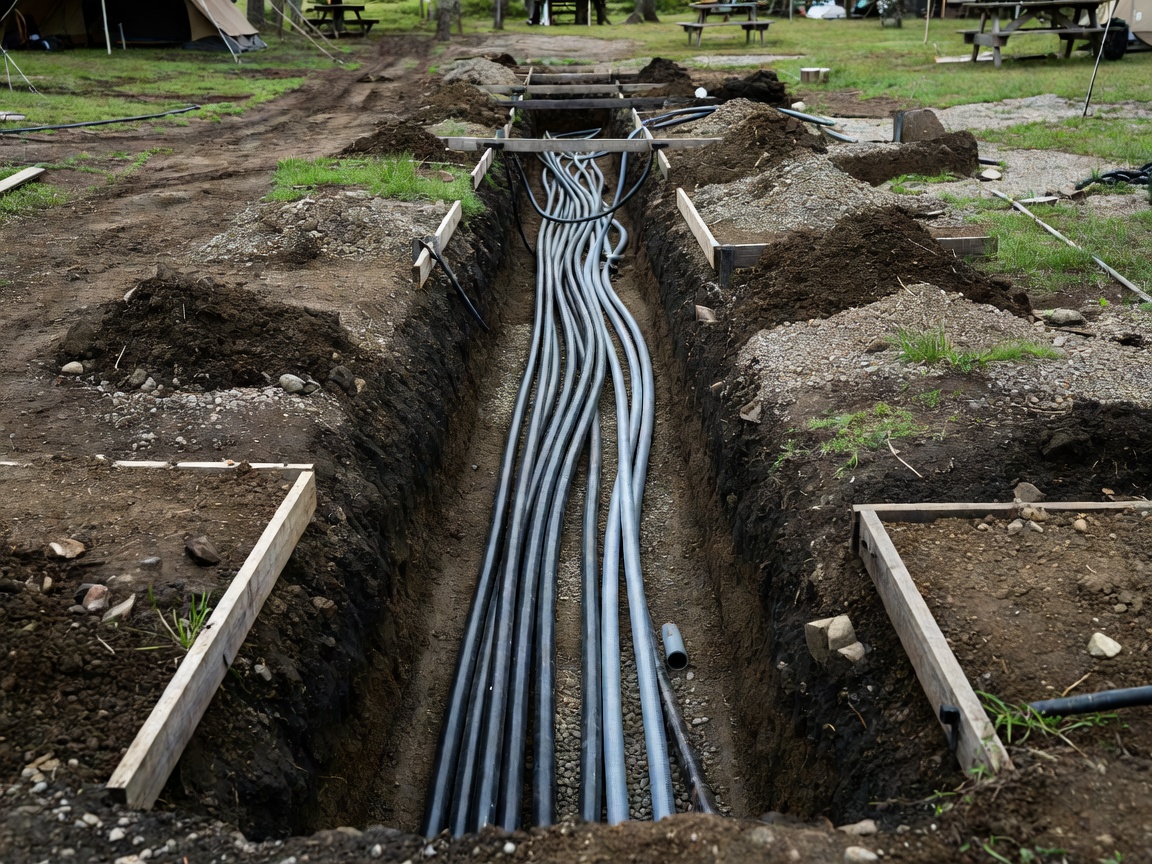
Modern practice favors ring-main distribution. By routing high-density polyethylene (HDPE) lines in closed loops around pitch clusters, water circulates from two directions to any active fixture. This balances static pressure throughout the park, minimizes sedimentation, and permits the isolation of a single cluster via gate valves during maintenance without shutting down water to the entire property.
Critical Subsurface Separation
Always maintain a minimum horizontal distance of 40 to 60 cm between potable water mains and wastewater/greywater lines in shared service corridors. Potable water must always sit above drain lines to prevent cross-contamination in the event of pipe subsidence.
Wastewater and Greywater Management
Modern caravans and campervans carry substantial onboard greywater tanks that need sanitary discharging. Without adequate disposal infrastructure, careless emptying into surface runoff ditches causes foul odors, insect breeding, and serious environmental penalties from regional European environmental agencies.
We recommend establishing dedicated motorhome service bays with heavy-duty cast-iron silt traps and accessible drain gullies. For individual premium pitches, installing dedicated sealed greywater connection points (typically 40mm to 50mm smooth-bore connections) lets guests drain sinks and showers continuously without surface splashing.
Seasonal Demand Equalization and Frost Preparation
Unlike suburban municipal utilities that experience relatively predictable daily loads, a campsite's water usage fluctuates wildly between the quiet spring months and peak school holiday weekends. Furthermore, in regions prone to heavy frost—such as the Ardennes, Bavaria, or the French Alps—shallow water lines will freeze and split if not drained thoroughly.
Every lateral spur line must terminate with an accessible drain cock placed at the lowest topographic point. When the site shuts down in October or November, technicians can isolate the main stopcock, open the low-point valves, and use an oil-free air compressor to purge lingering moisture from the pipes.
Practical Utility Checklist
- Loop Design: Main delivery pipes form continuous rings without stagnant dead-end branches.
- Frost Depth: Main conduits buried below regional frost line depths (typically 60–100 cm).
- Backflow Prevention: Double check valves installed on all communal washdown and chemical toilet taps.
- Sectional Isolation: Ball valves placed at each pitch cluster to isolate leaks without disrupting full operations.
Common Utility Planning Mistakes
One frequent mistake is neglecting tracer wire when laying non-metallic HDPE piping. Because plastic pipes cannot be located with standard magnetic detectors, future excavators or fence installers risk shearing live water conduits. Tape a copper tracer wire alongside the pipe bedding, and log GPS coordinates during open-trench installation.
Another pitfall is failing to account for slope gradients in gravity sewer routing. A wastewater slope that is too shallow leads to solids accumulating; a slope that is too steep allows liquids to drain away while leaving solids behind. A consistent 1% to 2% gradient is the recognized engineering target for campsite sewer collection lines.
Advantages and Inherent Limitations
Advantages: Looped networks yield uniform water pressure, lower risk of bacterial stagnation, simplified segment-by-segment repairs, and prolonged pipe lifespan.
Limitations: Initial trenching costs are higher due to double routing, and terrain obstacles like solid bedrock or established tree root zones require careful navigational directional boring.